
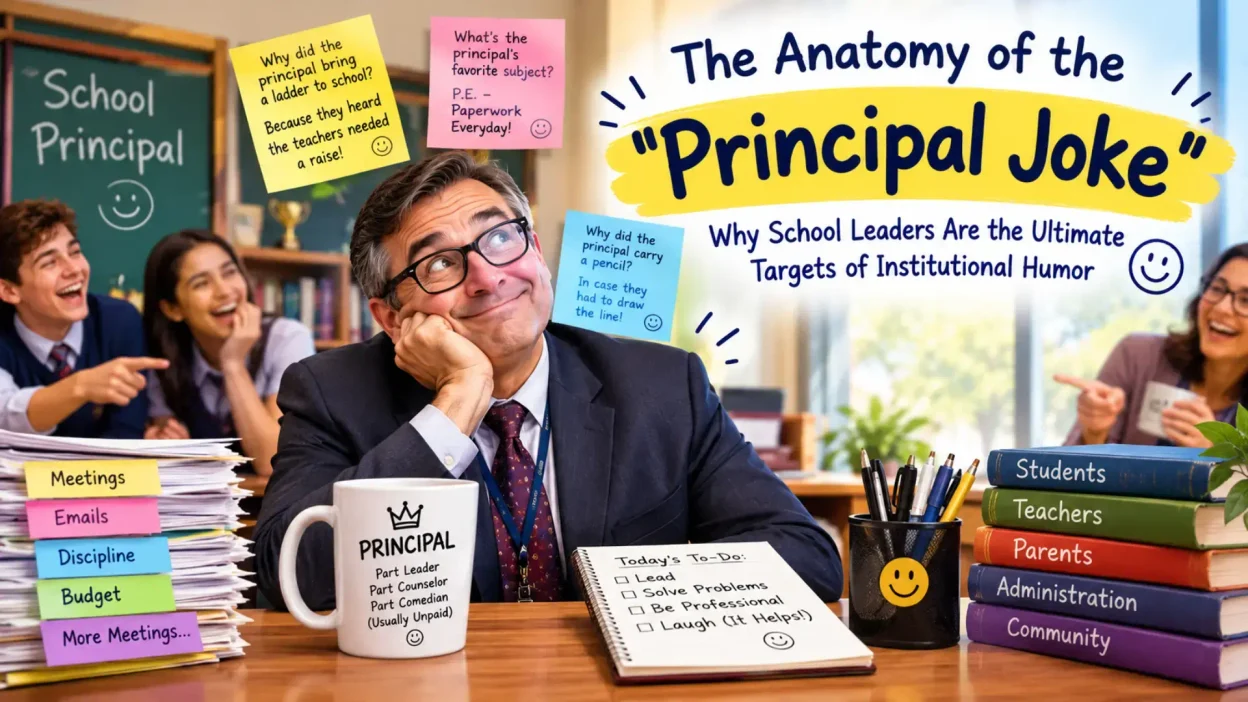
School life is a universal human milestone that bridges cultures, generations, and geographies.
Long after graduation, the echoes of the morning bell, the rigid structure of the classrooms, and
the looming authority of the school principal remain vividly etched in our collective memory. The
principal stands as the apex authority figure of our youth—an omnipresent manager pacing the
corridors, dispensing disciplinary action, and commanding instant silence via the public address
system.
Humor has long served as humanity’s most effective tool for humanizing the unapproachable.
When an individual exercises absolute systemic control over your daily routine, reframing that
authority through a comedic lens offers psychological relief. Whether expressed as an innocent
pun for primary school children or a deeply structured narrative where the leader dreads the
institution itself, this humor actively diffuses administrative friction and fosters psychological
equilibrium.
The Psychology of School Humor: Why the Principal?
According to classical psychological frameworks of humor—specifically Relief Theory and
Incongruity Theory—comedy manifests when a subject tied to high anxiety, strict discipline, or
institutional weight is suddenly subverted by an unexpected punchline. The principal’s office is
structurally tied to consequences; transforming that space into a setting for a joke immediately
neutralizes the underlying stress.
For Students: This humor serves as a form of “innocent rebellion.” It allows young minds to
process authority figures safely, replacing intimidation with a healthy framework of respectful
parity.
For Teachers: Educational staff operate under immense systemic pressure, balancing
curriculum mandates, parental expectations, and top-down management. Sharing
administrative jokes acts as a crucial corporate coping mechanism inside the breakroom.
For Principals: Leaders who intentionally leverage or embrace self-deprecating humor are
structurally more effective. Deconstructing their own administrative weight builds professional
transparency and bridges the trust gap between management and staff.
Comprehensive Structural Overview of School-Based Humor
To fully dissect the taxonomy of school administration humor, the matrix below charts the primary
categories, psychological drivers, and target audiences of this comedic subset
| Joke Category | Primary Target Area | Psychological Driver | Best Suited Audience | Example Context |
|---|---|---|---|---|
| Wordplay & Puns | Title, Phonics, & Definitions | Incongruity & Language Mastery | Primary & Middle Schoolers | Simple, innocent word association ideal for announcements. |
| Narrative / Situational | Routine, Stress, & Burnout | Role Inversion (Leader as Victim) | High Schoolers, Teachers, Parents | Long-form storytelling reflecting shared administrative fatigue. |
| Administrative Satire | Bureaucracy & Budget Constraints | Systemic Frustration Relief | Senior Educators & Board Members | Dry, sarcastic critiques of slow corporate institutional processes. |
| Self Deprecating | Personal Flaws & Management Habits | Humanizing Authority & Trust Building | Entire School Ecosystem |
The Playground Puns: Lighthearted & Punny (Kids Edition)
These precise, clean linguistic jokes are tailored for early developmental stages. They leverage
auditory incongruities to stimulate language recognition and memory patterns.
The School Best Friend: Who is universally considered everyone’s best friend at school?
Punchline: The “Princi-PAL”!
The Playground Intruders: What did the principal say to the flock of noisy chickens on the
lawn?
Punchline: “We strictly do not tolerate fowl language on this campus!
The Disciplinary Clock: Why was the grandfather clock sent directly to the administrative
office?
Punchline: Because it was consistently running late.
The Locomotive Comparison: What is the structural difference between a school principal
and a freight train?
Punchline: The principal demands that you spit out your gum, whereas the train
screams, “Chew, chew, chew!”
The Measurement System: Why does the headmaster carry a massive wooden meter stick
to every board meeting?
Punchline: Because a great administrator must always know how to draw a firm line
Relatable Narrative Jokes (Adults & Parents Edition)

Longer, Narrative-Driven Humor: Structural Analysis
Longer, narrative-driven humor requires structural setups and relies on psychological identification with workplace fatigue and situational irony.
1. The “Monday Morning Blues” Narrative
Early on a rainy Monday morning, a tired mother entered her son’s bedroom to wake him for the upcoming week. “Wake up, son. It is time to prepare for school.”
The son pulled the heavy duvet over his head and groaned, “No, Mother, I refuse to go to school today. Give me two indisputable reasons why I must endure it.”
His mother folded her arms and replied calmly, “First, you are fifty-two years old. Second, you are the school’s principal.”
Analytical Value: This narrative expertly subverts expectation through role inversion, reminding audiences that institutional fatigue is not exclusive to youth.
2. The Magic Genie & The Institutional Priorities
During an archival clean-up in the school basement, the principal, a meticulous mathematics teacher, and a notorious backbench student unearthed an antique brass lamp. Upon polishing it, a genie emerged, granting them each a single wish.
The student eagerly yelled, “Transport me immediately to a tropical beach resort with endless food and absolutely zero academic responsibility!” Flash! The student vanished.
The mathematics teacher spoke next: “Send me to a secluded cabin in the Swiss Alps where I can enjoy complete silence and never grade an exam paper again!” Flash! The teacher vanished.
The principal adjusted his glasses, checked his wristwatch sternly, and barked at the genie: “I need both of them back in their respective classrooms before the lunch bell rings in precisely four minutes.”
Analytical Value: Illustrates the psychological reality of administrative conditioning, where compliance and scheduling override supernatural opportunities.
Administrative Sarcasm: Quick One-Liners for Corporate & Speeches
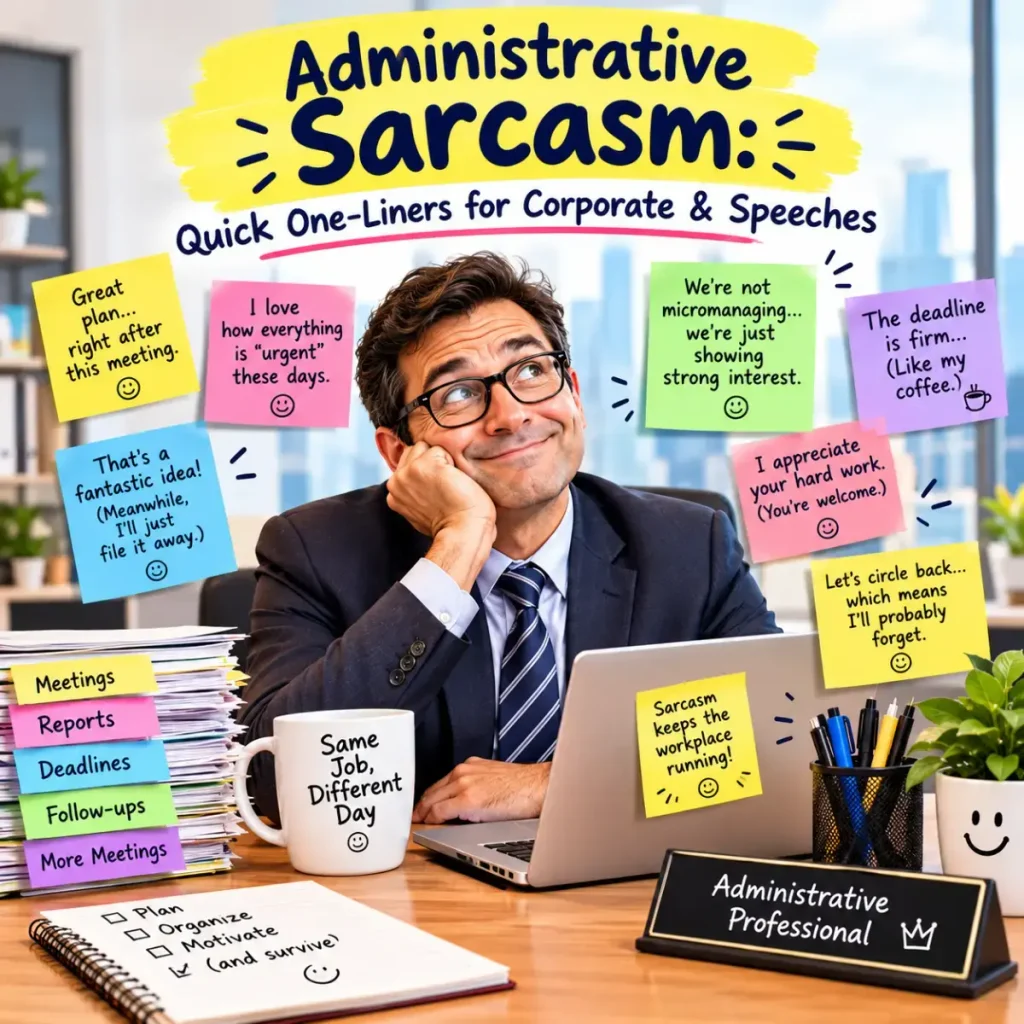
Ideal for retirement celebrations, regional educational conferences, and staff milestones, these concise lines slice through corporate formality:
- Why did the superintendent bring a twenty-foot ladder to the facility upgrade evaluation? They were instructed to take the campus to a higher level of education.
- Why did the computer science principal consult a medical doctor? Because they caught a digital virus while scanning student emails.
- What did the vintage art piece mounted in the administrative office whisper to the drywall? “Don’t look at me, I was completely framed!”
- How many school administrators does it take to safely replace a faulty incandescent lightbulb? The exact number remains unknown, as they are still awaiting formal budget approval from the district committee.
FAQs
Culled from ongoing digital discussions across education subreddits (e.g., r/teachers) and institutional management threads, these FAQs address the deeper socio-cultural dynamics of educational humor:
Why do child-centric puns like “princi-pal” trigger collective groans or eye-rolls from adults?
This traces back to cognitive development. Children find joy in phonological similarities and basic wordplay because their linguistic maps are actively forming. For adults, humor requires advanced situational nuance, subverted logic, or irony. Consequently, basic auditory puns are classified as low-effort “dad jokes.”
Can educational professionals safely publish satirical anecdotes about their administration anonymously online?
While sharing macro-level memes or generic system critiques on platforms like Reddit is widely protected, specific anecdotes carry risk. If unique parameters (e.g., precise timelines, regional slang, distinct campus architectures) allow reader identification, it can be interpreted as professional insubordination or a breach of social media policy, jeopardizing employment stability. Anonymity requires total stripping of local context.
How can an incoming campus principal systematically deploy humor to build immediate rapport with an insulated staff?
The gold standard is controlled, self-deprecating humor. By making light of their own administrative hurdles, coffee dependency, or the absurd volumes of systemic paperwork, an incoming leader disarms the natural defensiveness of the faculty. It signals that the leader values human experience above bureaucratic perfection.
What is the underlying socio-historical origin of the classic “Principal refusing to go to school” joke archetype?
This format evolved from early 20th-century industrial workplace humor, originally centered on corporate factory overseers. The structural mechanism relies on extreme role inversion. Because our brains are hardwired to associate school avoidance with childhood rebellion, the sudden revelation that the victim is the institution’s supreme controller creates a psychological break that forces laughter.
Are there specific boundaries where administrative humor crosses into toxic workplace territory?
Yes. Satire that targets an administrator’s work ethic—such as implying they merely sit in climate-controlled spaces drinking espresso while ignoring operational crises—can erode staff morale. Effective institutional humor must satirize the shared structural system or trivial human errors, never the baseline competence or integrity of the professional.
Conclusion: Laughter as an Administrative Tool
Principal joke are vastly more than trivial schoolyard distractions; they function as a vital systemic valve within the global education ecosystem.
They remind us that behind every strict dress code policy, institutional evaluation, and regulatory mandate is a human being navigating the complexities of leadership. Introducing healthy, intelligent humor into your campus culture does not diminish institutional authority—it fundamentally strengthens it.

Chloe Mitchell is a creative writer who loves clever wordplay, funny jokes, and memorable pickup lines.She enjoys turning everyday ideas into entertaining content that makes readers smile and share a laugh.